
You’ll learn:
Why everything keeps landing back on your plate (even when others could help)
Three simple, practical shifts you can set up this week
- How to start sharing responsibility without charts, nagging, or burnout

You’re not just doing everything.
You’re remembering everything.
The lunches.
The library day.
The form that needs signing.
The fact you’re almost out of shampoo.
It’s not just the physical load.
It’s the constant awareness running in the background of your brain all day.
And over time, without even realising it, you’ve become what I call the Household Google.
It’s something most of us step into slowly, without even realising it’s happening.
The one everyone turns to.
“Hey Mum… where’s my uniform?”
“Hey Mum… do I need money for tomorrow?”
“Hey Mum… are we out of cereal?”
And because you know the answers…
It’s faster to just respond.
To just do it.
To just carry it.
Until your business starts to feel like the neglected third child
and your brain never really switches off.
So where do you even start?
Not with a chore chart.
Not with a big family meeting.
And definitely not by just stopping everything and hoping it works itself out.
You start small.
You start visible.
And you start by shifting how information and ownership flows in your home.
Here are three places you can begin this week.
1. Laundry: Make it obvious so you can step back
Laundry is one of those things that quietly becomes yours.
Not because anyone decided that…
but because you’re the one who knows how it all works.
What goes where.
What gets separated.
What can’t go in the dryer.
So everyone else opts out before they even try.
It’s the same reason chore charts so often fall flat — they try to assign tasks without shifting ownership or understanding first.
Instead of asking for help, try this:
Set up a simple, visual system that removes the guesswork.
Here’s what this looks like in our house:
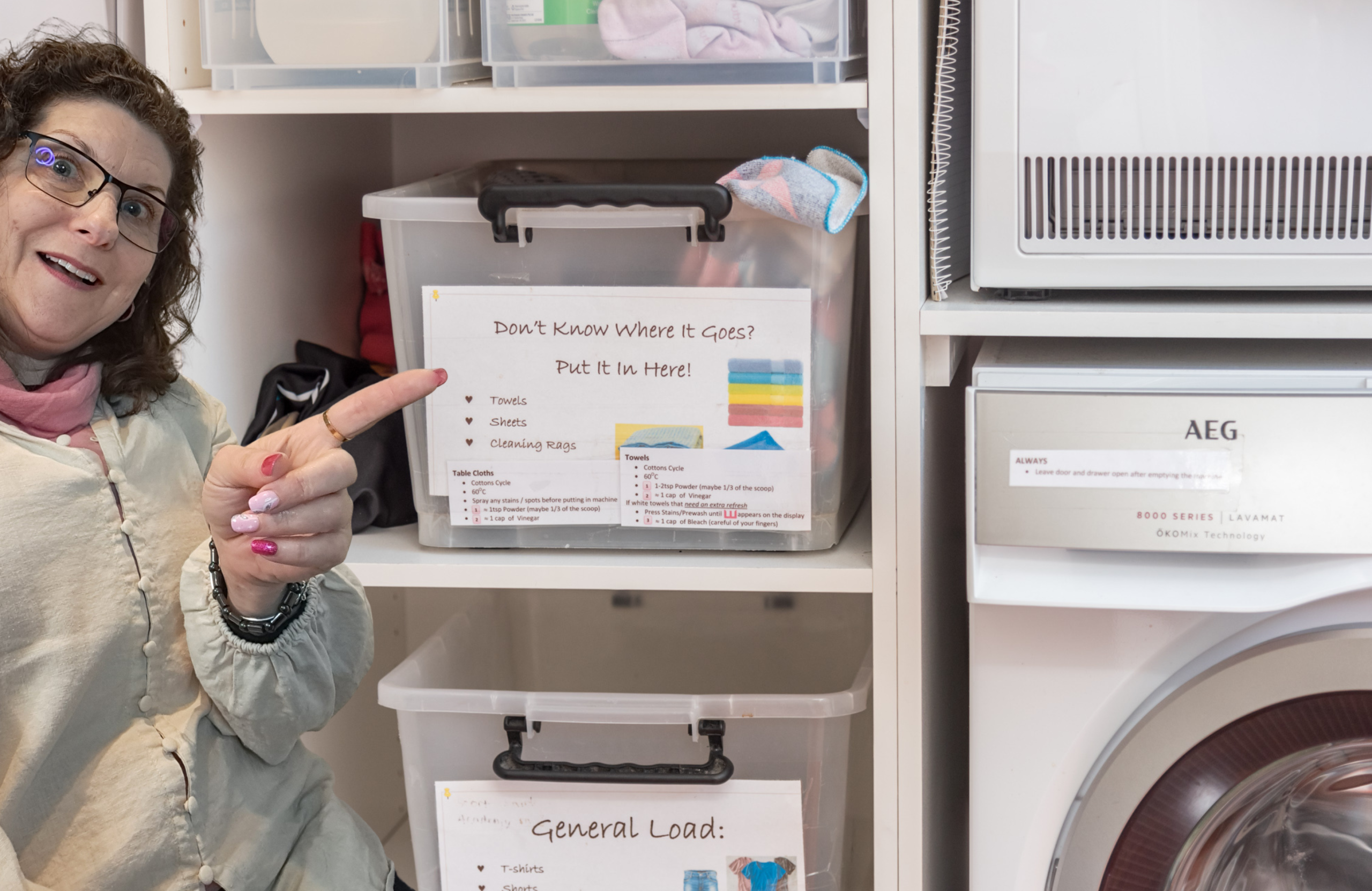
Label your laundry categories clearly.
Towels.
Sports.
General wash.
Add simple instructions if needed.
Then let your family know:
“I’ve set this up so it’s easier for everyone to get involved with the washing.”
Not: “Can you help me with the laundry?”
But: “Here’s how this works now.”
You’re not handing over tasks yet.
You’re removing the barrier that kept it sitting with you.
2. Meals (start smaller than you think)
Trying to “share the cooking” is often where things fall apart.
It’s too big.
Too vague.
Too easy to revert back to you.
So instead, shrink it right down.
Start with one simple part of the process: the shopping flow.
Create a designated spot in your kitchen
where empty packets, boxes, or jars get placed when something runs out.
Next to it, have:
- a running shopping list (paper or app)
- or a note that says: “Add it to the list before it goes in the bin”
Now the remembering doesn’t live in your head.
Anyone can see it.
Anyone can add to it.
Anyone can pick things up.
This is how you start shifting from:
“I need to remember everything”
to:
“We have a system that holds it”
3. School Communication: Share the access, then share the role
School admin is a classic Household Google trap.
Apps. Emails. Permission slips. Payments.
It all funnels through one person… usually you.
So even if someone wanted to help, they can’t.
Because they don’t have the information.
First step:
Make sure both parents have access to:
- school apps
- email communication
- login details
Then have a simple conversation:
“Let’s split this so it’s not all sitting with me.”
For example:
- One of you handles communication with teachers
- The other manages payments and permissions
It doesn’t need to be perfect.
It just needs to be clear.
And if it feels clunky at first?
That’s normal.
You’re shifting something that’s likely been sitting with you for years.
Why “just stop doing it” doesn’t work
You’ve probably heard this advice before:
“Just stop doing everything and they’ll figure it out.”
But here’s the problem.
If you drop the task without shifting the information,
you don’t create shared responsibility.
You create confusion.
And when things fall apart…
guess who it comes back to?
You.
Because “help” still keeps you as the one holding it all — it doesn’t actually change who it belongs to.
That’s why this isn’t about stepping back overnight.
It’s about:
- making things visible
- sharing information
- creating small entry points for ownership
So it doesn’t boomerang straight back onto your plate.
You don’t need to overhaul everything

You don’t need to do it all. You just need to start taking things off your plate.
You don’t need a full system by Monday.
You don’t need everyone doing everything.
You just need to start taking one piece off your plate
in a way that can actually stay off.
Because right now, it’s not just your time being used up.
It’s your head-space.
Your energy.
Your ability to focus on the things that matter to you.
And you deserve more of that back.

Want weekly ideas for what to do instead?
If this post made something click and you’d love gentle, practical ways to build shared responsibility (without charts, bribes or burnout), you’re welcome to join my weekly newsletter.
It’s where I share:
• real household shifts
• simple mindset flips
• and ways to stop carrying everything alone
Pop your email in below ↓